
From Eindhoven to SpaceX: a look behind the scenes at the people and technology that make heavy loads easier to move
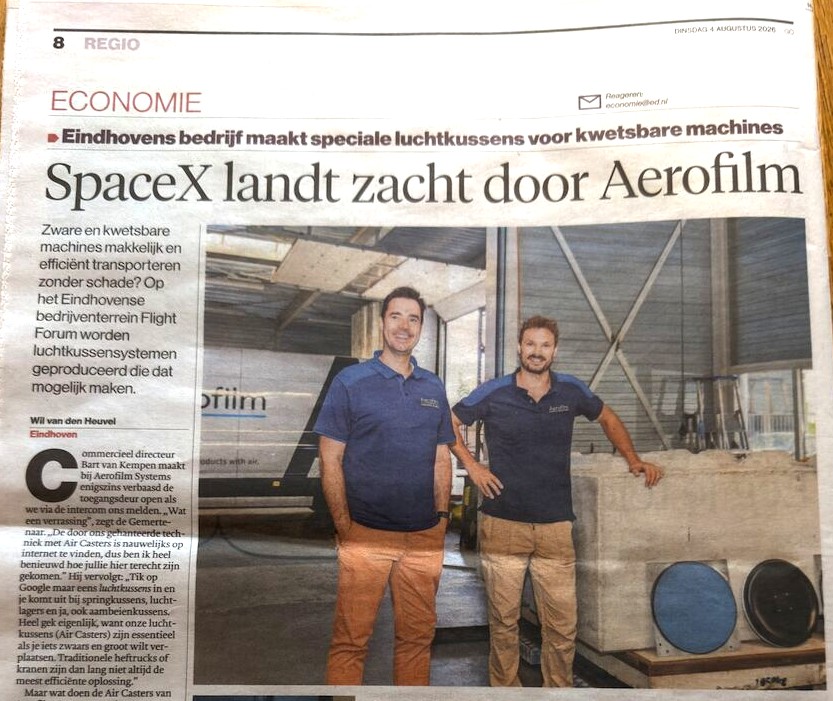
How do you move a machine weighing hundreds of tonnes without relying on rails, wheels or a crane? That question was at the centre of a recent article about Aerofilm Systems in Eindhovens Dagblad.
Under the headline “SpaceX makes a soft landing thanks to Eindhoven-based Aerofilm”, journalist Wil van den Heuvel visited our facility at Flight Forum in Eindhoven. The article takes readers behind the scenes of our production process and explains how a relatively simple principle, a thin film of compressed air, is used to move some remarkably heavy and sensitive loads around the world.
Heavy transport with a thin film of air
At the heart of the article is our Air Caster technology. Air casters create a very thin film of air between the load and the floor. Once the load is lifted onto this air film, friction is reduced significantly and even extremely heavy objects can be moved with relatively little force.
Commercial Director Bart van Kempen explains why this becomes particularly interesting as loads get larger:
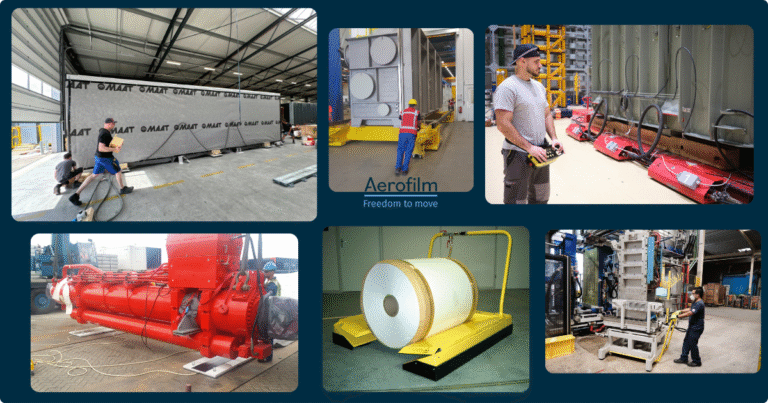
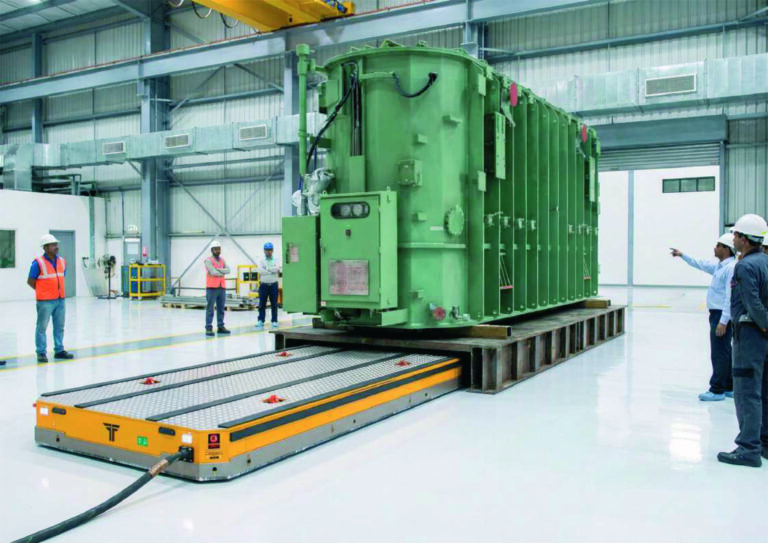
The principle itself may be straightforward, but the applications are anything but ordinary. Our systems are used for moving production machinery, transformers, large paper rolls and sensitive components in industries where conventional transport methods can become restrictive.
“On the floor of our workshop, loads of up to 10,000 tonnes can be moved in a controlled manner. This happens without particularly high forces being applied to the floor itself. Our air cushions are essential when something is really heavy and large.”
From Eindhoven to the aerospace industry
What starts in our production facility in Eindhoven eventually finds its way into factories and industrial environments around the world.
The Eindhovens Dagblad article highlights applications ranging from a new tyre factory in Vietnam to the aerospace industry in the United States. Companies including SpaceX and Blue Origin use Air Caster technology in their operations, while other examples include the movement of transformers weighing hundreds of tonnes.
That international reach contrasts with the relatively compact team behind the technology. Aerofilm employs around twenty people in Eindhoven, with engineering and production kept close together.
Experience you cannot simply replace
The article does not only focus on technology. It also highlights something that is just as important to us: the experience behind it.
Technical Director Michiel Driessen points to the production team and the knowledge required to manufacture Air Casters consistently and efficiently:
“Normally, that would take around seven days of work. We do it here with ten people in a week.”
Several members of our team have been with Aerofilm for more than ten years. Some have decades of experience with the materials, production methods and practical details behind Air Caster technology.
That knowledge matters. Air Casters may look relatively simple from the outside, but producing them consistently for demanding industrial applications requires experience that is built up over years.
Keeping engineering and production together
Another subject covered by Eindhovens Dagblad is our decision to keep production in Eindhoven.
Rather than separating engineering from manufacturing, both remain closely connected. When an application requires a different configuration or when something can be improved in production, the people involved can work directly together.
For a technology that is often adapted to unusual loads, environments and customer requirements, those short lines make a difference.
Eindhoven technology travelling around the world
Perhaps the most interesting contrast in the article is the scale.
Aerofilm is a relatively small family business in Eindhoven, yet the technology produced here is used for projects involving some of the world’s largest machines, industrial installations and aerospace companies.
The loads can weigh hundreds or even thousands of tonnes. The principle that gets them moving can be less than a millimetre thick.
Sometimes, a little air is all it takes.