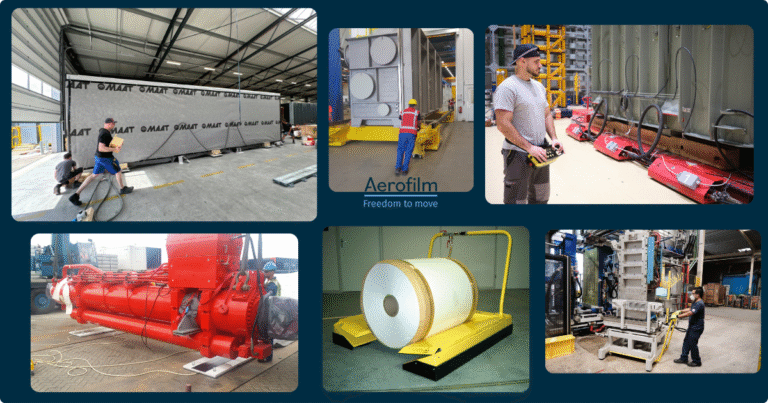

When discussing heavy transport, the conversation often starts with one question: How much does it weigh?
While weight is important, it is often not the deciding factor when selecting a transport solution. Other important factors must be considered, just like how that weight is transferred to the floor, its distribution.
To better understand this concept, let’s compare two important variables:
Weight versus pressure
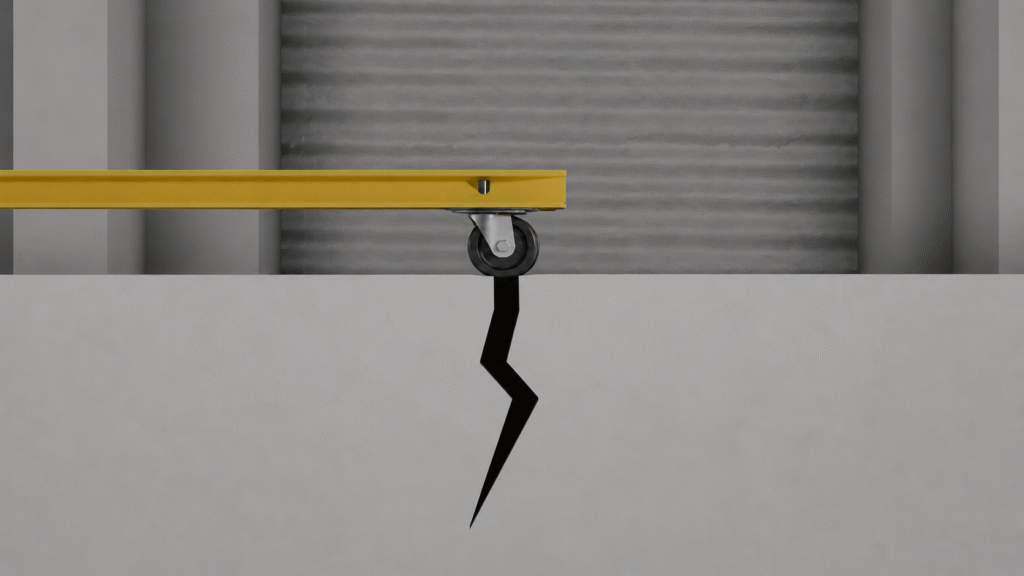
Many heavy loads can be moved using wheels or roller systems. However, these solutions transfer the load through relatively small contact points which leads to a high pressure concentration on those contact points.
As loads become heavier, more or bigger wheels are required to distribute the weight. Even then, floor loading remains concentrated at specific points. This can lead to increased floor stress or breakage, reduced maneuverability and limitations when operating on sensitive surfaces.
Air casters take a different approach.
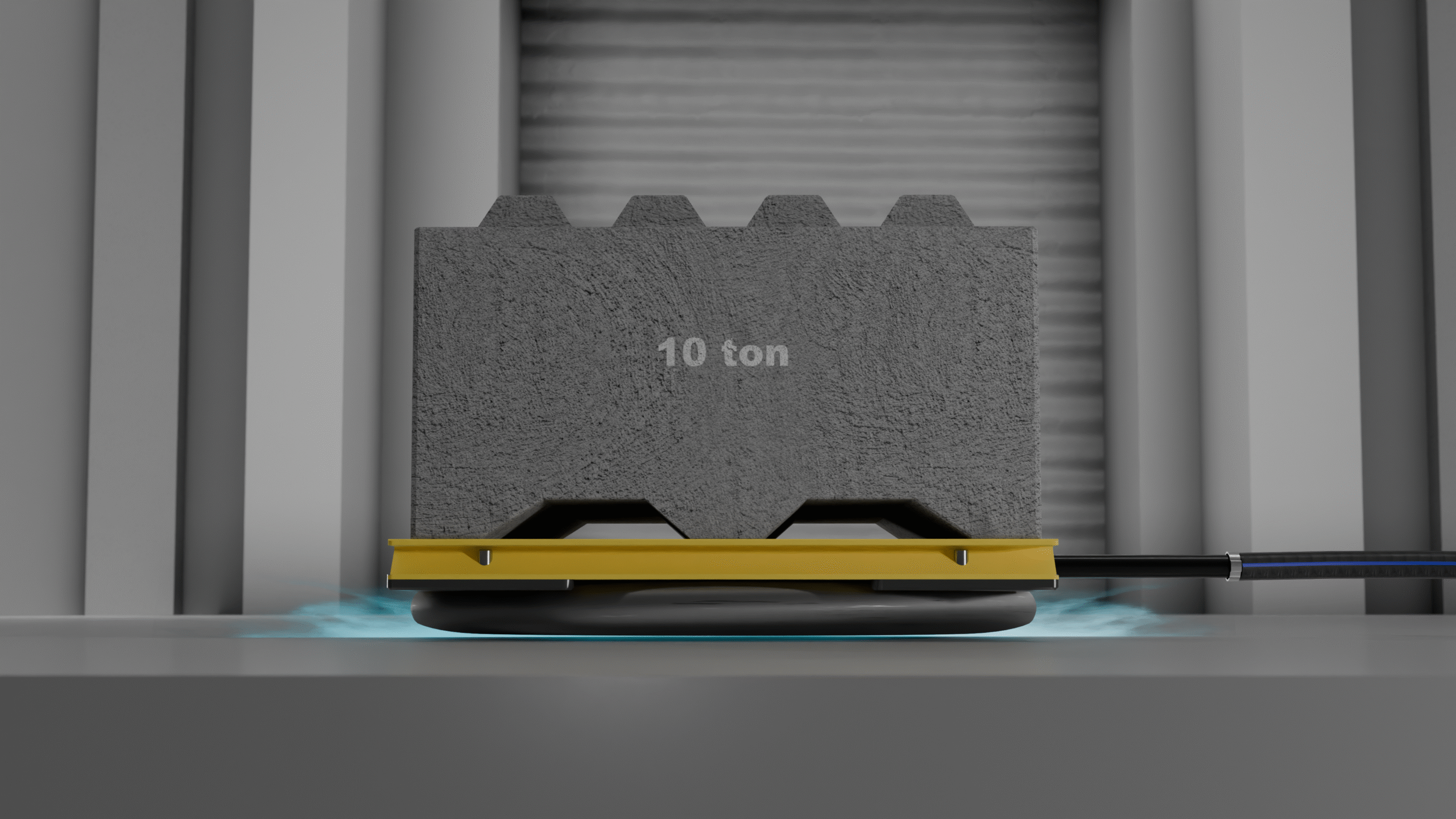
Instead of supporting the load on a number of small contact points, the weight is distributed across the entire surface area covered by the air cushions. The difference is not the amount of weight being moved but how that weight is distributed.
The principle is simple: the larger the surface area in contact with the floor, the greater the weight that can be applied to it. Therefore less chances of breaking.
“We can compare it to walk on soft wood with normal shoes, or do it on high heels. The chances of the wood cracking wearing high heels are much higher because of the contact point being much smaller.”
A larger contact area
A typical air caster has a much larger contact area than a wheel. When multiple air casters are used together, the load is spread evenly across a significant portion of the floor surface.
To achieve a comparable contact area using wheels, dozens of wheel assemblies may be required depending on the application. This larger footprint creates several advantages:
- Lower floor pressure
- Reduced risk of floor damage
- Improved load stability
- Smoother movement of heavy equipment
- Less dependency on complex wheel configurations
For facilities handling transformers, modular structures, industrial machinery or other heavy loads, these benefits can have a direct impact on operational efficiency.
Nevertheless, we cannot disregard the fact that floor needs to be strong enough to carry the load.
Why this matters for heavy industry
In industries where loads regularly exceed tens or hundreds of tons, floor conditions become a critical factor. A transport solution is only as effective as the surface supporting it.
By distributing weight over a larger area, air casters help reduce localized floor loading. This often makes them particularly suitable for facilities where floor preservation, flexibility and maneuverability are important considerations.
The result is a transport system that allows heavy loads to move with control while minimizing stress on both the floor and the equipment itself.
More than friction reduction
Air casters are often associated with frictionless movement and that is certainly one of their advantages, but there is more to it. The technology also changes the way forces are transferred between the load and the floor. By distributing weight more evenly, air casters create a transport solution that combines mobility with stability.
Looking beyond the weight
When evaluating a transport solution, it is tempting to focus solely on load capacity.
But weight alone does not determine performance. We need to answer questions such as: How is the load distributed? Can the floor handle high pressure? Air caster technology addresses these questions through a simple principle: distribute the load over a larger area and eliminate friction wherever possible.
So the challenge is not how to support more weight, but instead which solution is more suitable to distribute that amount of weight, while guaranteeing safety and durability.